Posted 5/23/2026
In a previous article, we questioned the efficacy of police body-worn cameras by asking, "Are police body cams working?" The foundational purpose of these devices is to illuminate moments when an officer's conduct is called into question—enhancing transparency, ensuring accountability, and securing reliable evidence. They also protect officers by documenting instances where citizens break the law or behave aggressively. The underlying assumption has always been that when the visual facts are irrefutable, justice will be properly administered.
To test that assumption, we look closer at the tragic death of Tyre Nichols, a 29-year-old Black man who was fatally assaulted by Memphis police officers in 2023 just minutes from his mother's home. Bodycam and street-surveillance footage clearly captured five officers—Tadarrius Bean, Demetrius Haley, Emmitt Martin, Desmond Mills, and Justin Smith—viciously beating Mr. Nichols during what they claimed was a routine traffic stop. An internal investigation later concluded there was absolutely no proof that Mr. Nichols had violated any traffic laws.
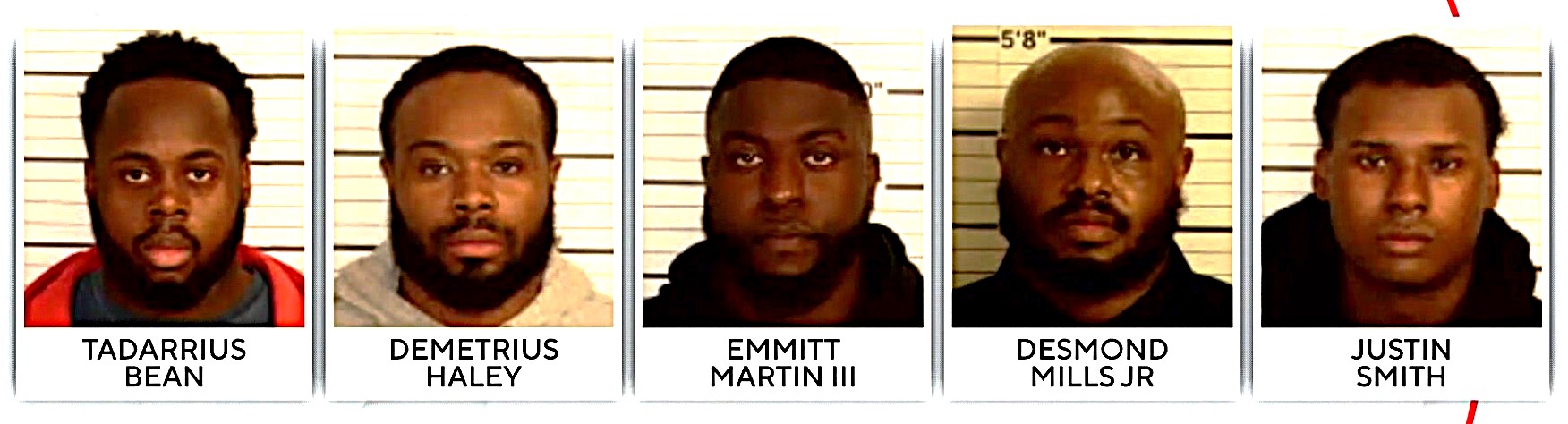
All five men belonged to the SCORPION unit, a specialized task force heavily criticized by community activists and civil rights lawyers for its aggressive tactics, unconstitutional stops, and history of excessive force. Ironically, SCORPION was an acronym for "Street Crimes Operation to Restore Peace in Our Neighborhoods." Instead, the unit brought violence, and Mr. Nichols succumbed to his injuries three days later. The coroner ruled his death a homicide caused by blunt force trauma to the head, neck, and torso, which resulted in brain contusions, internal hemorrhaging, and liver failure.
Following the video's public release, the condemnation was swift and widespread. New York City Police Commissioner Keechant Sewell denounced the "disgraceful actions," while Chicago Police Superintendent David O. Brown called the footage "horrific." FBI Director Christopher Wray stated he was "appalled," and Patrick Yoes, national president of the Fraternal Order of Police, declared, "The event as described to us does not constitute legitimate police work or a traffic stop gone wrong. This is a criminal assault under the pretext of law." You may Click Here if you choose to see the video for yourself. But be warned, it is graphic and very disturbing.
The legal fallout from the Tyre Nichols case highlighted a deep disconnect between video evidence and courtroom outcomes. While two of the officers pleaded guilty to avoid trial, the remaining three faced a state court trial where they were completely acquitted of second-degree murder, aggravated assault, aggravated kidnapping, and official misconduct. On the surface, it is incomprehensible how a jury could watch definitive video proof of a man running for his life from a torturous assault and reach a unanimous not-guilty verdict. But the camera only captures the data; it is the jury that interprets it.
The venue of the trial played a massive role in this dynamic. Memphis is a majority-Black city (roughly 63% Black, 23% White, and 10% Hispanic). Citing pervasive local media coverage, Shelby County Criminal Court Judge James Jones Jr. granted a defense motion to move jury selection over 300 miles away to Hamilton County (Chattanooga)—a region that is 70% White and only 18% Black. The justification was to avoid a jury biased by local familiarity with the SCORPION unit's reputation. In effect, an entire city was eliminated from the peer group evaluating the crime.
When the trial began, the final jury selected was entirely White. Interestingly enough, Black Americans have been excluded from juries on several occasions, and it occurs far more often than many realize. Historically, Black individuals are frequently eliminated from jury pools due to felony conviction disqualifications—a barrier that disproportionately impacts Black men, an estimated one-third of whom carry a felony record. Furthermore, while the landmark 1986 Supreme Court case Batson v. Kentucky made it illegal to strike jurors strictly based on race, the practice persists through peremptory challenges, which allow defense attorneys and prosecutors to dismiss a specific number of prospective jurors without providing a reason. The disqualification of Black jurors has existed throughout the history of America... Click Here.
Justice is defined as the ethical principle that all individuals should be treated fairly, impartially, and given their exact due. Moreover, retributive justice demands a proportionate punishment for wrongdoers. When an all-White jury looks at a video of a fatal beating of a Black person and determines there was no criminal wrongdoing, it exposes a severe vulnerability in the system. The law is ultimately interpreted by people, and because people carry deep-seated biases, prejudices, and differing worldviews, even the most irrefutable video evidence can become as subjective as beauty in the eye of the beholder. It must be noted that the officers responsible for the 2011 killing of Kelly Thomas, a White man, were acquitted as well... Click Here
To be continued...