Posted 9/27/2026
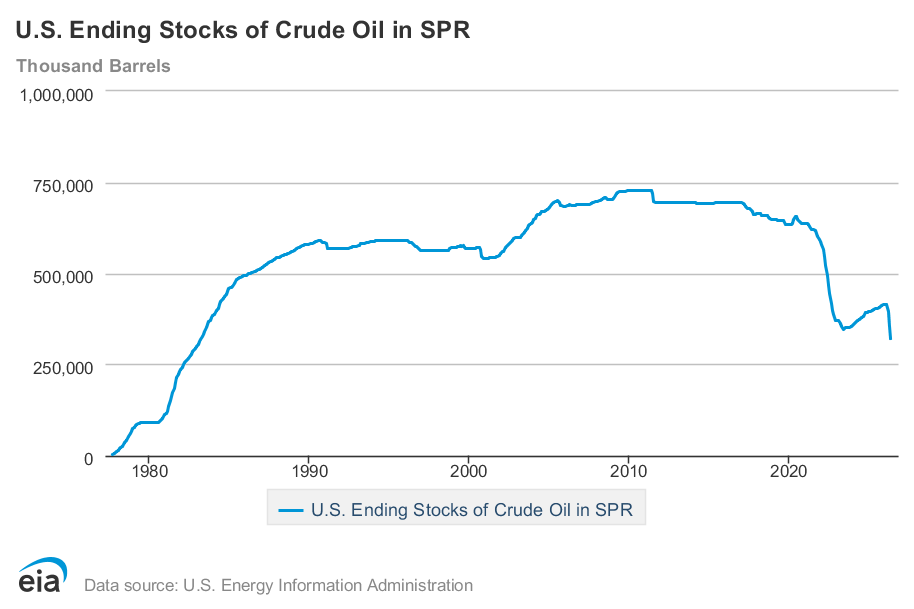
It has been reported that the U.S. Strategic Petroleum Reserve (SPR) stands at approximately 284.55 million barrels, marking a 43-year low. This is 40% of its capacity and down from 405.73 million barrels a year ago. The shortage has been driven by emergency draws following the 2022 energy crisis and the ongoing conflict with Iran.
The United States produces a massive amount of oil, but it cannot fully sustain itself with domestic crude alone due to a mismatch between the type of oil it extracts and the design of its domestic refineries. Domestic fields mostly produce "light, sweet" crude, while many U.S. refineries are built to process "heavy, sour" crude, which is thick and high in sulfur, imported from places like Canada, Latin America, and the Middle East.
The cost of transporting domestic oil is high. The infrastructure to move oil efficiently between production regions like Texas and refining hubs located in the Northeast or on the West Coast isn't adequate. The Jones Act, a federal law from 1920, exacerbates the situation. It requires goods shipped between U.S. ports to move on American-built, flagged, and crewed ships, which limits available tankers and makes shipping prohibitive. More drilling does not instantly lower prices or bypass these physical and economic restraints.
Because the U.S. trades on the global market, local gas prices still rise or fall based on international events, regardless of domestic production levels. OPEC holds roughly 80% of the world's proven crude oil reserves. A small group of individual nations—primarily Venezuela, Saudi Arabia, Iran, Iraq, and the UAE (United Arab Emirates)—account for the vast majority of these stored resources. Venezuela alone accounts for 20% of the world's total oil reserves.

Photo courtesy of Jennifer Jacquemart
Though the United States uses the most oil of any country, consuming roughly 19 to 20 million barrels per day, the European Union is also facing a price crisis as a result of the Iran war. Countries are urged to be conservative and minimize the usage of energy for what is expected to be a prolonged duration. EU energy commissioner Dan Jorgensen said, "I invite you to consider taking or continuing to take measures that can sustain [gas storage] injections or reduce gas and electricity demand for as long as necessary." In the states, the national average price for regular gasoline has gone up by about $1.80 per gallon (roughly a 64% increase), rising from around $2.81 in January 2026 to approximately $4.61 by late September 2026.